
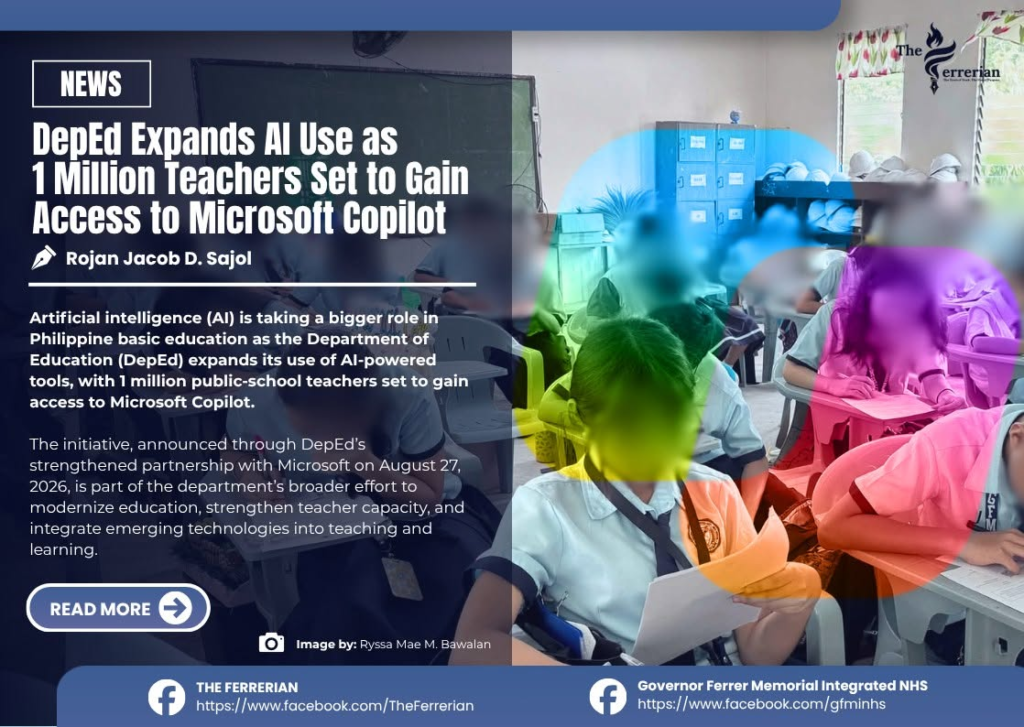
Artificial intelligence is taking a bigger role in Philippine basic education as the Department of Education (DepEd) expands its use of AI-powered tools, with 1 million public-school teachers set to gain access to Microsoft Copilot.
The initiative, announced through DepEd’s strengthened partnership with Microsoft on August 27, 2026, is part of the department’s broader effort to modernize education, strengthen teacher capacity, and integrate emerging technologies into teaching and learning.
Through the partnership, Microsoft will provide access to Copilot, which can assist teachers in preparing lesson plans, developing learning materials, handling administrative tasks, and analyzing information to help them respond more efficiently to learners’ needs.
For DepEd, however, the initiative goes beyond giving teachers another digital tool. It forms part of a broader push to integrate emerging technologies into education while addressing persistent learning gaps and strengthening teachers’ capacity to use AI effectively.
“Our learners deserve an education system that is ready for the future,” Education Secretary Sonny Angara said. He added that the partnership aims to help teachers save time, engage learners better, strengthen classroom teaching, support learning recovery, and prepare Filipino children for an AI-driven world.
The move builds on DepEd and Microsoft’s previous work in learning recovery. Under the Academic Recovery and Accessible Learning (ARAL) Program, Microsoft tools such as Reading Progress and Reading Coach have been used to support reading development and help teachers identify learners’ needs.
A 21-week pilot involving more than 3,400 students across eight regions reported measurable improvements in reading. Of the participating learners, 780 showed reading progress, with 319 moving to a higher Philippine Informal Reading Inventory (Phil-IRI) band and 461 improving within their existing band.
DepEd has also been strengthening teachers’ AI literacy. Its nationwide AI-skilling initiative earlier this year attracted nearly 75,000 live participants, while registrations exceeded 175,000 educators, reflecting growing interest among teachers in learning how to use AI in their professional practice.
Microsoft, meanwhile, is extending its AI partnerships beyond the education sector. On August 22, PLDT Inc. and its wireless subsidiary, Smart Communications Inc., expanded their use of Microsoft 365 Copilot after deploying 1,000 seats across the organization. The technology is being used in areas including finance, procurement, customer service, human resources, and other internal operations to support tasks such as analysis, information management, and decision-making.
While the partnerships demonstrate the growing role of AI in both education and the workplace, DepEd’s initiative carries a broader implication for Philippine schools: AI adoption is shifting from experimentation toward institutional use.
With 1 million teachers potentially incorporating AI into their professional work, the challenge for the education sector is no longer simply gaining access to the technology. It is ensuring that teachers are equipped to use it critically, responsibly, and in ways that genuinely improve learning.
As DepEd moves further into the AI era, technology may become a stronger part of the classroom, but its success will ultimately be measured not by how often AI is used, but by how effectively it helps teachers teach and learners learn.
Image by: Ryssa Mae M. Bawalan